I can’t tell you I have a favorite sus2 form beyond the full barre with a 5th-string root, but working these out suggested some nice alternatives to work into progressions. In fairness, they are all triads, but I labeled the easy to grab three-note shapes as triads here.
Dominant 7’s cover the last remaining core 4-note chord in the arsenal. I struggle to employ them effectively in composition as well, but this one is clearly on me. Dominant chords are the heart of the blues and jazz and are no strangers to rock.
Unlike Maj7 chords, I end up using the minor 7th all the time. Social distancing seemed like a great time to start mapping out a chord vocabulary, so here come all of the minor 7th chords I frequently use.
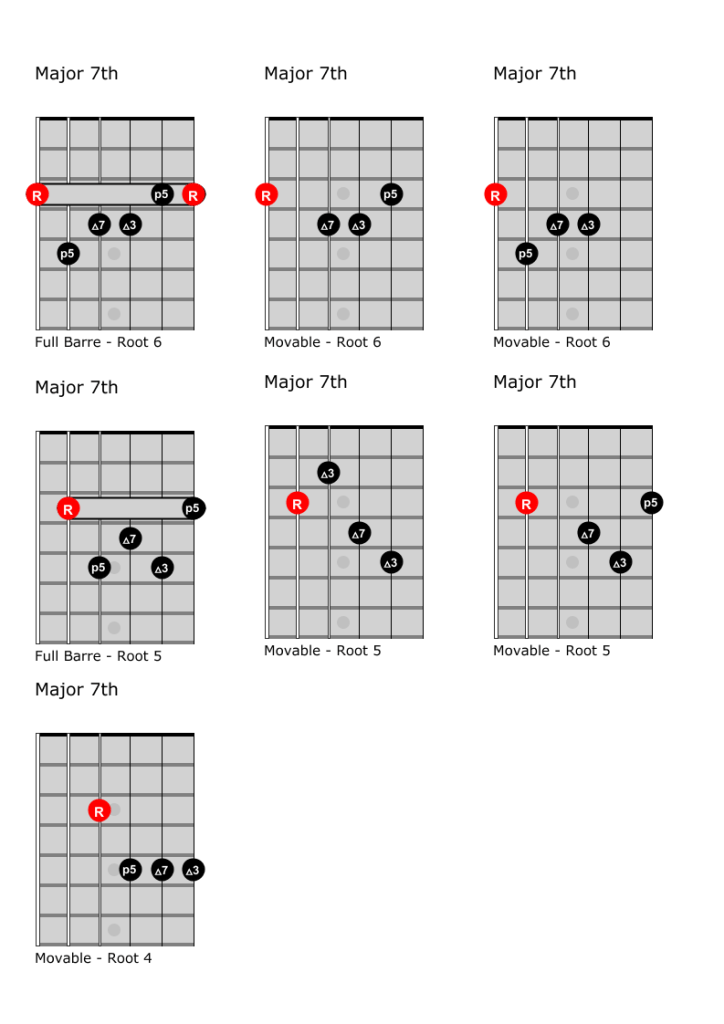
I find Maj7 chords to be more difficult to use than triads or min7 chords, and I don’t seem to be entirely alone. Finding rock songs that feature the Maj7 wasn’t as easy as I expected. Here’s what I found: U2 One, Led Zeppelin The Rain Song, Paul McCartney Band on the Run, Peter Frampton Show me the Way, and John Lennon’s Imagine. In jazz, I’m pretty confident this would be a lot easier, and I’d also guess that if I’d scoured the Steely Dan catalog, I’d have come up with more good examples.
Easily placed or not, it’s a good place to start when it comes to cataloging voicings being the 4-note form of the first degree of the major scale. Below are all the voicings I find most useful for a Maj7.
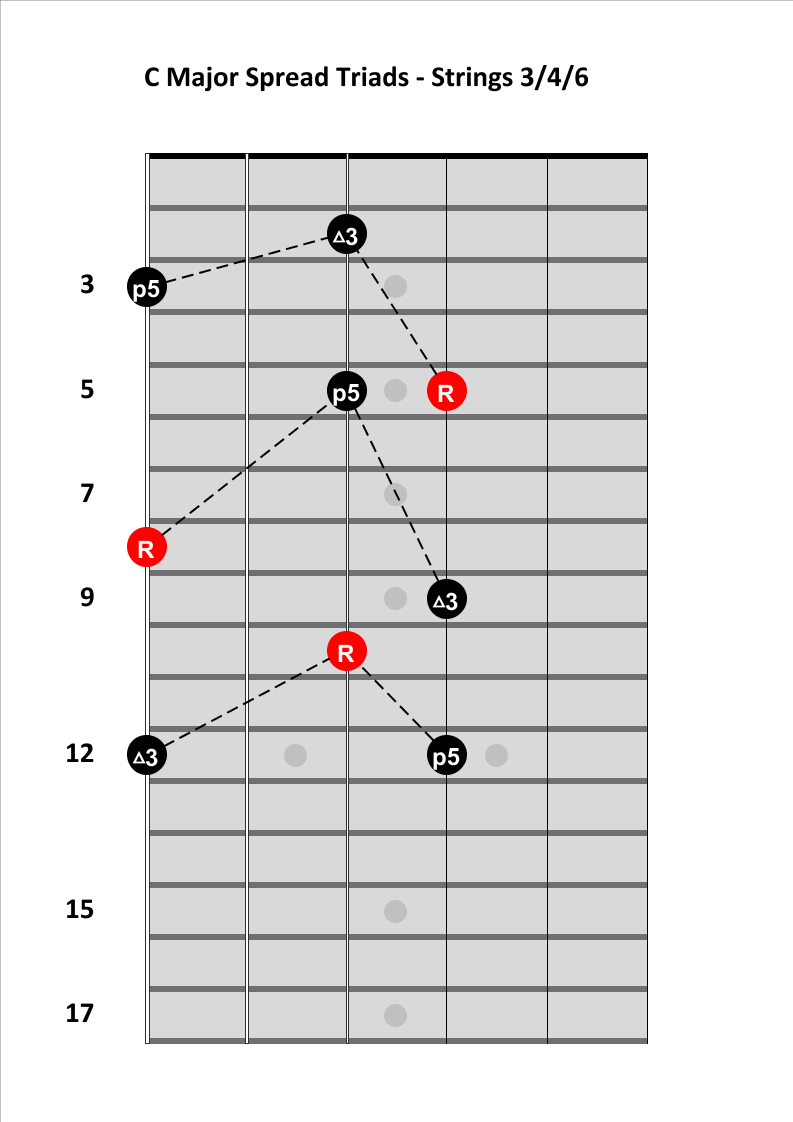
I’ve had trouble finding good simple charts of spread triads. Rick Beato did a great video on them recently, but I had trouble finding a simple reference for spread triads in his book (which I’d highly recommend here, as it is freakishly comprehensive). I figured it was worth working out my own reference to share on Pedal On. Here are the major spread triads with their bass note on the lowest string. They aren’t all easy to play, but they sound great. I’ll work across the strings and then into minor and maybe beyond.
Truefire has become an indispensable resource for me in the past couple of years. The quality of material on the site coupled with the reasonable cost of courses make it a no brainer if you’re looking to make consistent progress in your playing. Their Guitar Lab: Triads course inspired me to map out triads up and down the neck along with extensions in each position, some of which you already see here. Bruce Arnold’s Guitar Physiology course has noticeably helped to me keep my wrist and hand in healthier shape than it used to be, something that will pay dividends for years to come.
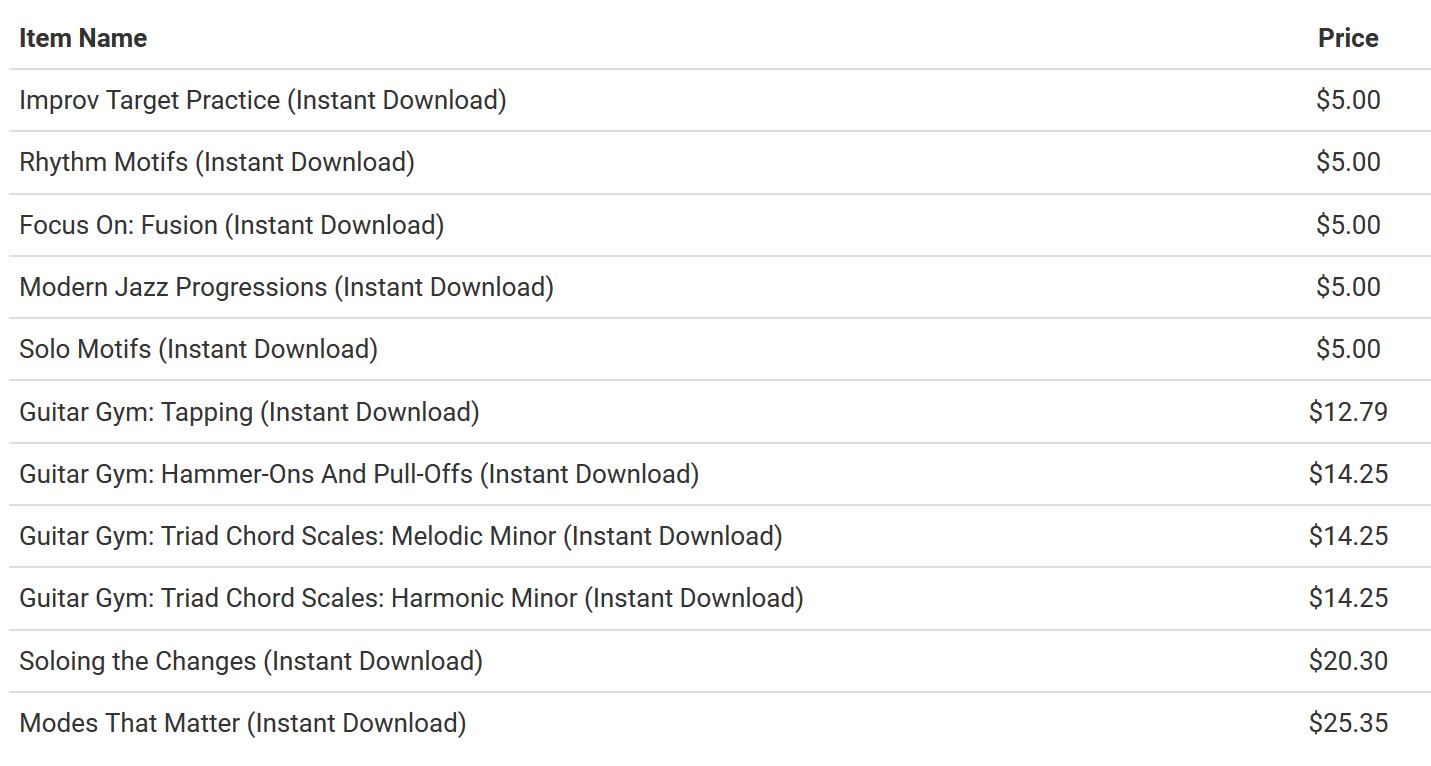
I picked up about 10 classes worth of new material in their holiday sale (for barely more than $100, you can see them all below). There’s nowhere else that I know of to get this level of instruction without paying a lot more or working with a top notch teacher in person. I’ve actually taken a couple lessons with both Jon Finn (Improv Target Practice) and Jeff McErlain (Soloing the Changes), and I don’t think my recent purchase even covers an hour of of their time.
Here’s a link to a tool I run from my personal page. It allows you to pick a home key (Major/Ionean) and see everything I could come up with that qualifies as an interesting substitution or borrowed chord. I’m sure there will be more to add down the line, but I’ve barely scratched the surface of putting these into practice.
Dominant triads can be put together by dropping the root or the fifth, assuming you have a root from a bassline or keyboard. I don’t use a ton of dominant chords, but I think its another tool I personally need to beef up. Here’s the top three strings:
This particular shape of the minor 7 is one of my favorites. It’s easily movable and removes the extra 5th from the typical barre chord, which leaves more space for the rest of a track without sacrificing complexity.
I’ve always found Phrygian difficult to use, but using the characteristic flat second in the context of a minor arpeggio rounds off some of the edges. These tend to look a bit scale-like, but really you find the main pinky-ring-index motion up the core of the arpeggio remains the same, and you just have the extra ♭2 to color the sound.





 Pedal On