This one shows up everywhere as well, and it’s very helpful to know your options when looking for embellishments.
This one shows up everywhere as well, and it’s very helpful to know your options when looking for embellishments.
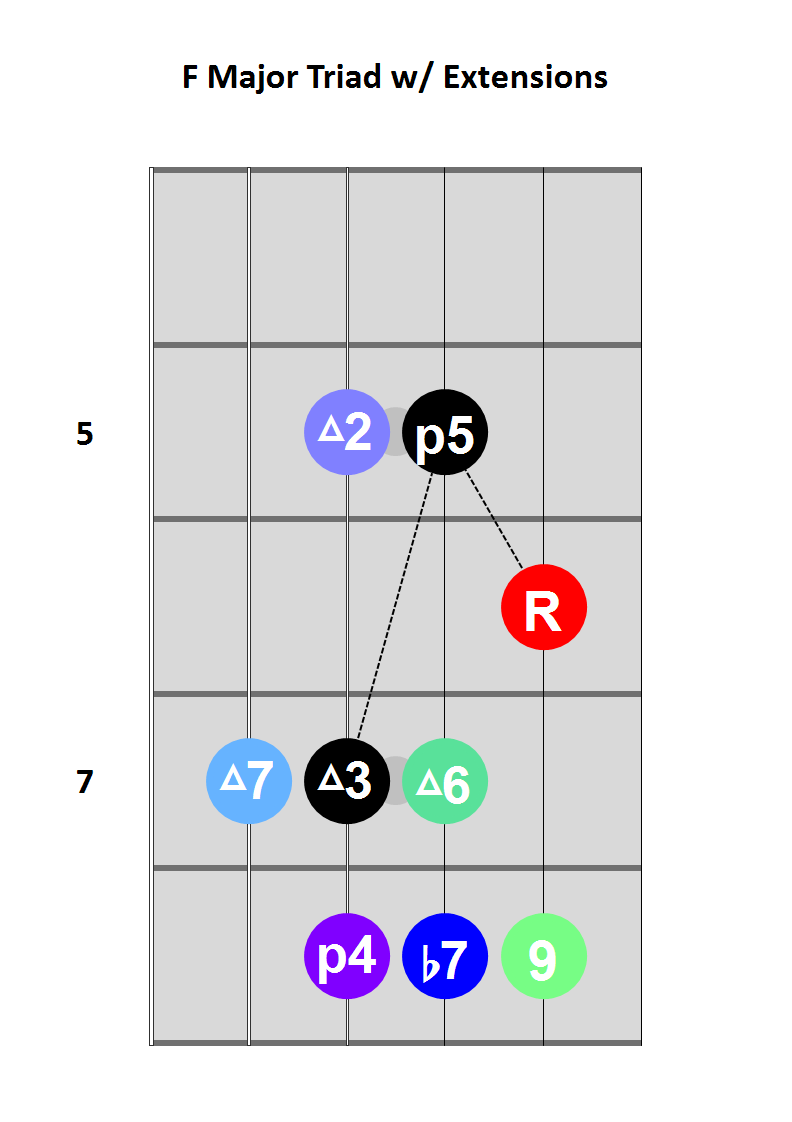
The most frequent triad I grab is still this one. Adding extensions, suspending the third, or even dropping the root in favor of the maj. 7 all make this shape a lot more interesting than the basic 1/3/5.

I recently picked this one up from a book of jazz chords. I love the sound of the 4th/11th versus the 5th with the m7 still in there.


These are probably the most useful major close position triads on the neck, or at least the ones I grab most frequently. I’ve been working through triads and spread triads to have a full range of them on tap as needed. Nothing fancy but worth committing to memory, particularly including the interval locations.

I’ve always found Phrygian difficult to use, but using the characteristic flat second in the context of a minor arpeggio rounds off some of the edges. These tend to look a bit scale-like, but really you find the main pinky-ring-index motion up the core of the arpeggio remains the same, and you just have the extra ♭2 to color the sound.

Minor sister to Lydian. I’ve found this to be a good way to highlight the key tones of the Dorian mode. Outside of the major sixth, there’s no difference between this and natural minor.

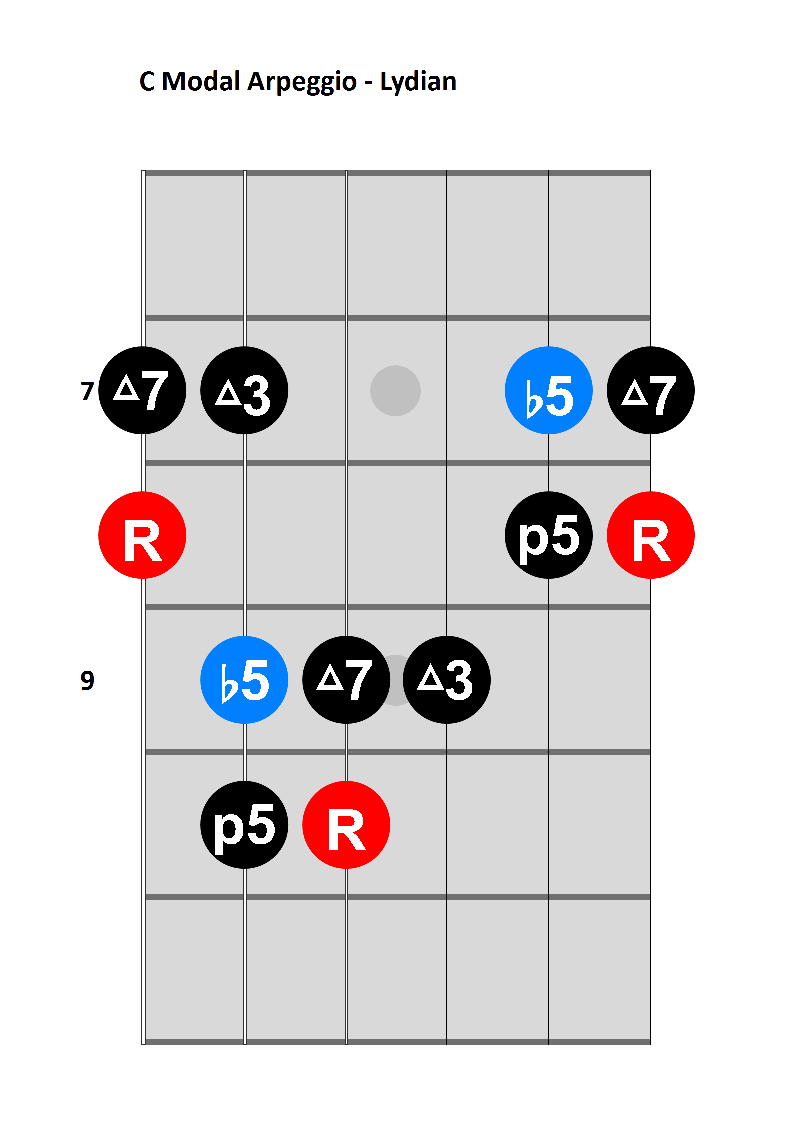
I’ve been struggling with ways to highlight modal sounds lately and figured I should try and work out characteristic arpeggios. I don’t know if this is an accepted concept or not, but I’ve found it useful, so figured I’d throw them out there. The first one is a Lydian arpeggio, which is just the major 7 with an added #4/#11.
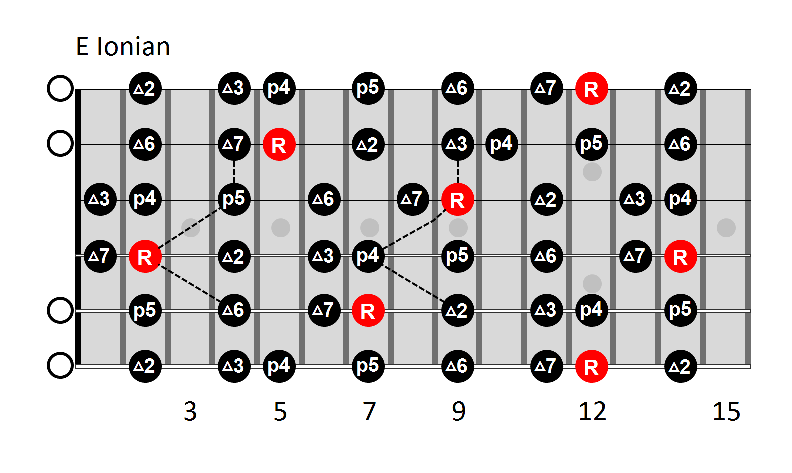
Only recently have I discovered just how many good chordal options there are to add character to improvised guitar work. One of the most useful is the m9 chord. Not only is this a fantastic chord on its own, but the 5th string root shape lives in a number of places in the diatonic scale (in its various flavors) and adds a complex character that varies with the underlying harmony.
Once you know it’s there in the main Dorian/Lydian, Ionian, and Mixolydian shapes, it becomes a very useful resting point, arpeggiated pattern, or transition between scale shapes. As a chord that shows up twice in the diatonic scale, the m9 provides a harmonically interesting way to move up or down the neck, and it only becomes more useful when you’ve mapped out the 5th-string root shapes across the whole scale. These are comfortable shapes to grab with plenty of harmonic depth to keep things interesting.
Try working the m9 options below into an improvisation, and try using the same shape in its alternate location in the scale for an entirely different harmonic relationship.


 Pedal On