On to strings 2/3/4. No shortage of options here either. For the rootless versions, it’s easiest helpful to think about placing the minor 7th position relative to the target root.
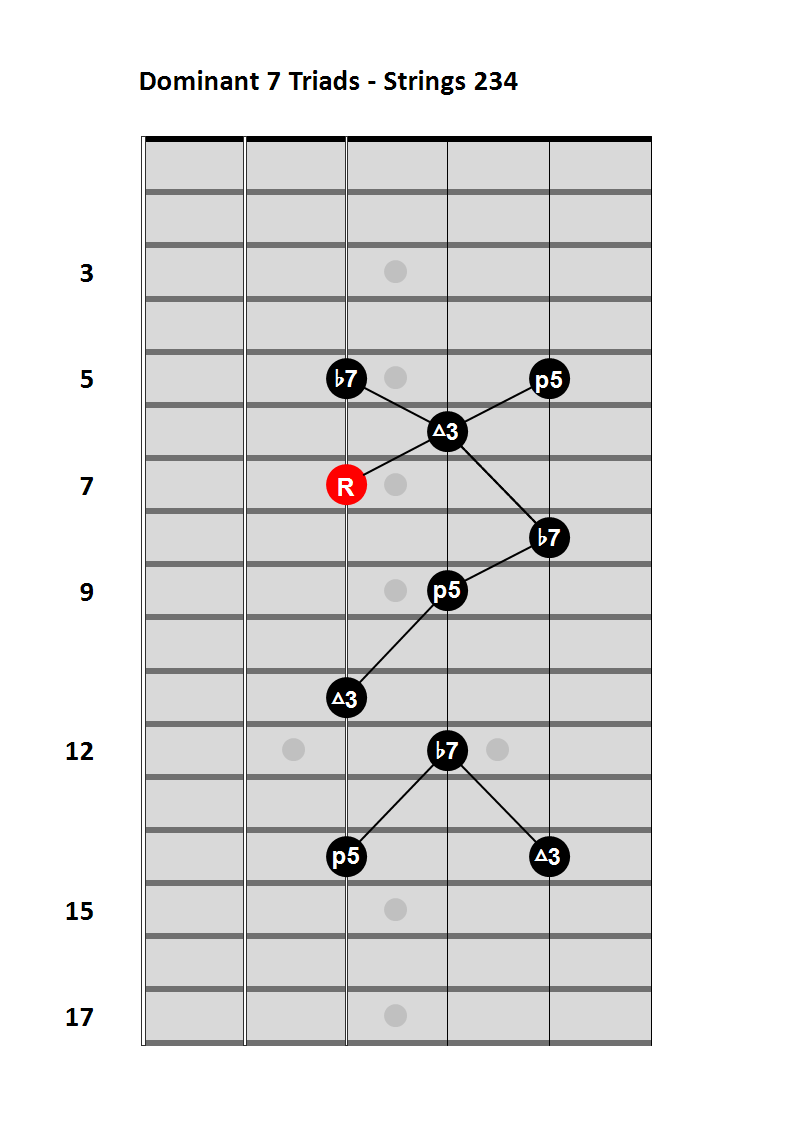
On to strings 2/3/4. No shortage of options here either. For the rootless versions, it’s easiest helpful to think about placing the minor 7th position relative to the target root.
Dominant triads can be put together by dropping the root or the fifth, assuming you have a root from a bassline or keyboard. I don’t use a ton of dominant chords, but I think its another tool I personally need to beef up. Here’s the top three strings:

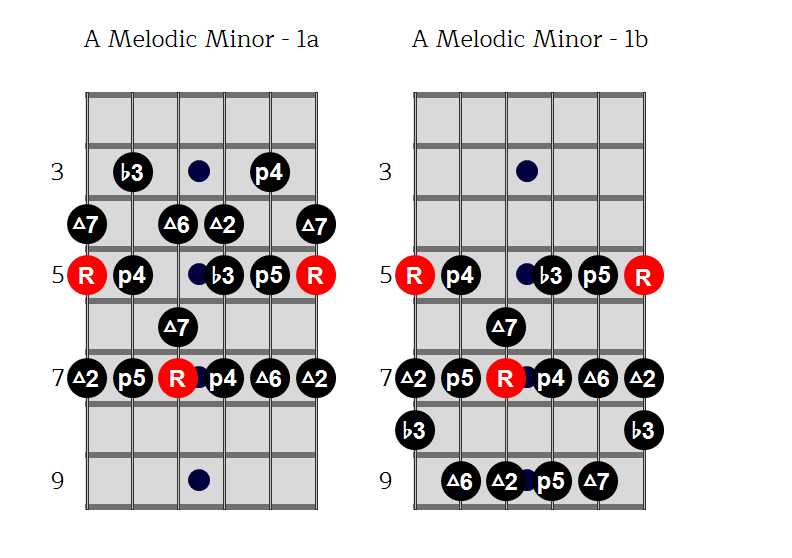
After listening to a good amount of Holdsworth (and watching this insane video: https://www.youtube.com/watch?v=wts2Mw6Nb5s&t=54s), I’ve realized I need to expand beyond just straight major/minor modes. Here’s an exploration of Melodic Minor in its first position. There are two natural ways to view it in this position, and I don’t have a strong view as to which feels more natural, if either.
Programming rhythms is one of my weakest skills, so I need all the help I can get. Without any training on real drums, I often find the hardest part is simply getting started with something that isn’t just kick on the 1 and 3 or four on the floor. What I’ve begun doing is to start by simply picking two accented kick notes before anything else. The beat below was something I quickly put into my TR-09. I wouldn’t call it exciting, but was fifteen minutes of work and it’s a lot more interesting than what I’d normally come up with in a short period. The placement of the main kick notes on the 1 and the and of the 3 dictate much of what other sounds will fit once these main hits are in place. Instead of putting together one mediocre rhythm in an hour of work, I managed to put four into the box that had more potential to drive interesting progressions or melodies.

This particular shape of the minor 7 is one of my favorites. It’s easily movable and removes the extra 5th from the typical barre chord, which leaves more space for the rest of a track without sacrificing complexity.

Here’s the second set of Major Key triads (in B this time) starting off the second inversion of the I chord (second string root). These have a nice flow and the I and IV shapes here should probably be old hat even if just as part of familiar bar chords.

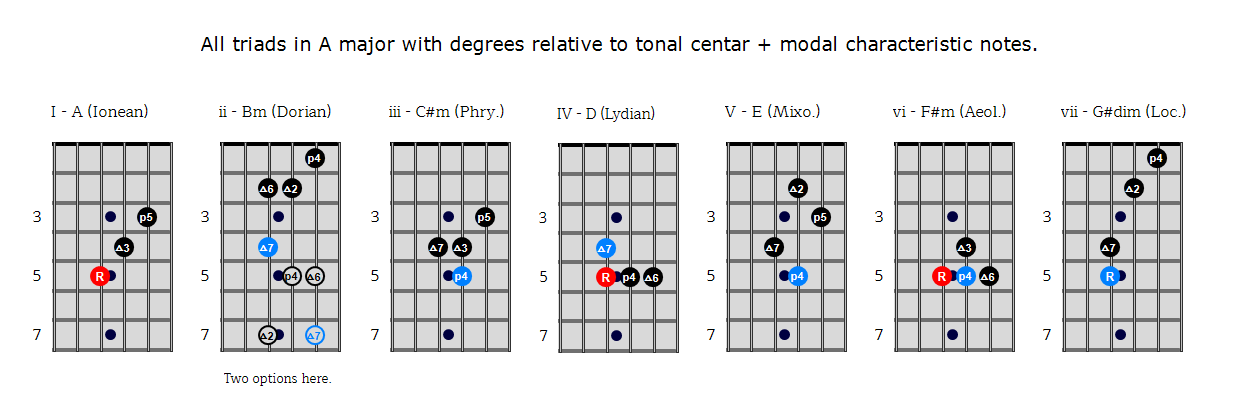
This is the first of an exploration into mapping out all triads in a key in close proximity. There’s no shortage of locations to work from, but this is the starting point I grab most frequently. Also included are characteristic notes for the associated modes to help add color highlighting where you are in the key. All labels are relative to the key center.
On to the top three strings. I’ve personally never spent enough time on the shapes on these strings, so this is a useful learning exercise, and hopefully sharing these proves helpful more broadly. I’ve certainly never noticed that barring the top three strings gives you a major sixth or that you have a useful, easy sus2 in most pentatonic boxes.

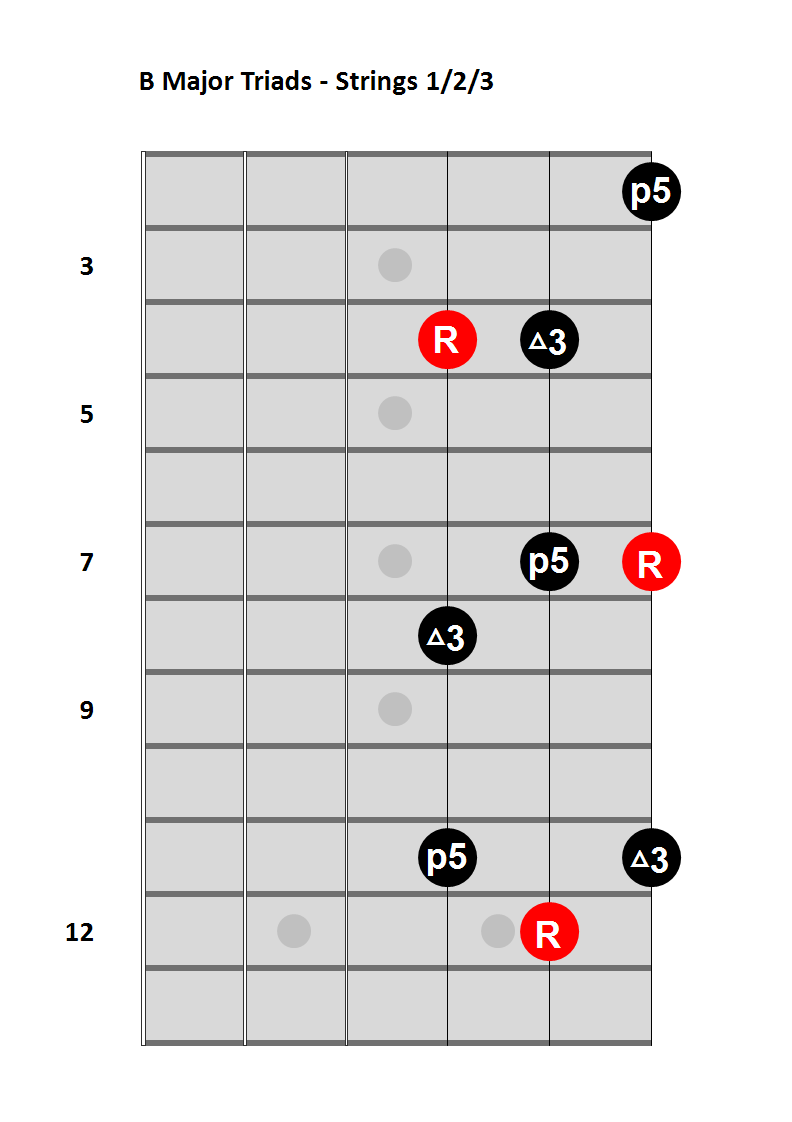
It’s time to move onto the triads on the first three strings. I’ve neglected learning these for far too long personally, so a good study of the major triads on 1/2/3 is warranted. It’s also probably time to start looking at the minor triads on both sets, which are easy to get to from their major counterparts.
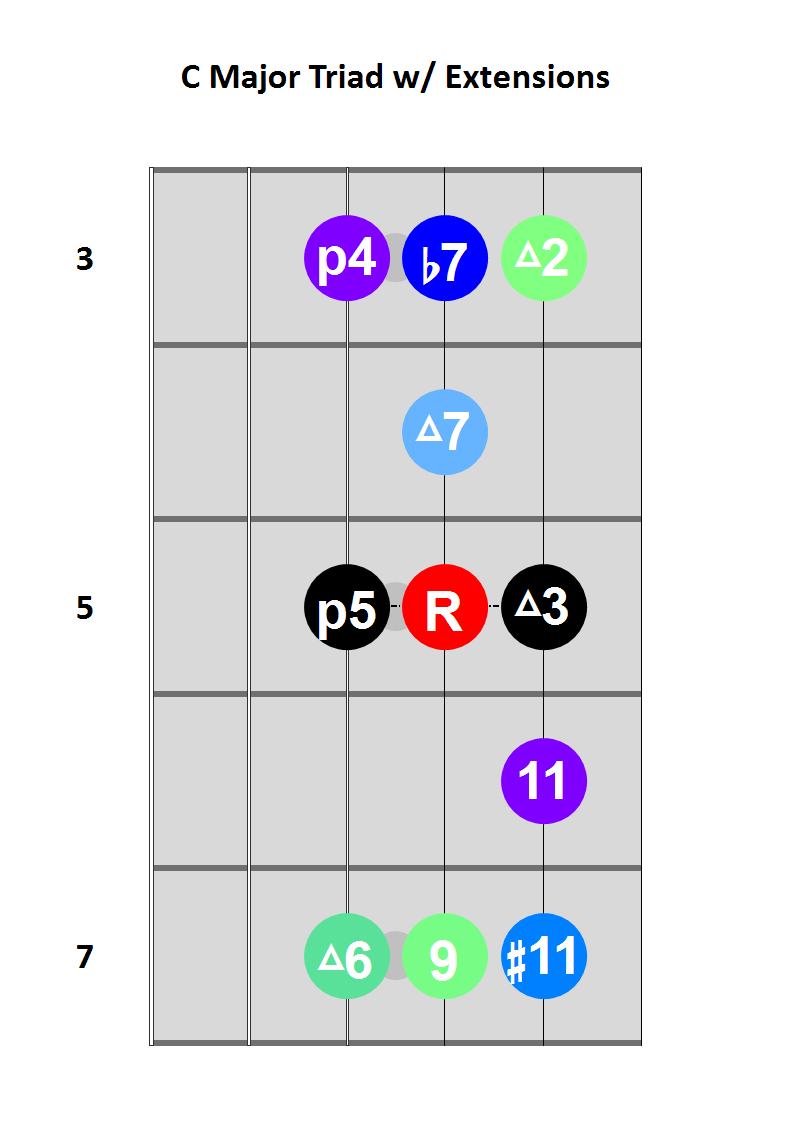
One last useful triad on strings 2/3/4. We all probably know this one, though I’ve never looked for the extensions until now. Knowing how to alter this simple bar is a great tool.
 Pedal On