6/9 Chords

This one is quite uncommon in rock or pop but easy to find in jazz where it’s usually used as a more interesting tonic chord. The only obvious place I could find this in the rock world was America’s Horse With no Name where the second chord of the main vamp is a 6/9. Interestingly, this chord contains the entire major pentatonic scale and is also a set of stacked fourth intervals, meaning you can play a whole barred figure at any fret and technically be playing a 6/9 chord with the root on the third string. I’d think you’d want a strong bass note behind the guitar to make that work. I haven’t tried it, but I thought it was interesting enough to include.

Min 6 Chords

To be fair, I mostly threw this one in for the sake of completeness. I won’t claim I’ve had much success with the min6, though I did enjoy the root-5 variation that looks like an ‘M,’ as it is easily dropped to a minor add-b13 chord that I’d never played before. I also found that this chord works much better for me in arpeggio form. Sounding the notes individually scales the heavy dissonance back to a more usable tension, a strategy I plan to test further in other chords I’ve had trouble using.

Maj 6 Chords

The major sixth is another chord that feels more jazz than rock or pop, but you don’t have to look too hard to find it in use. Lenny by Stevie Ray Vaughn and Sun King by The Beatles are the best two rock/blues examples of a major 6th chord that I came across.

Major 7th Chords

I find Maj7 chords to be more difficult to use than triads or min7 chords, and I don’t seem to be entirely alone. Finding rock songs that feature the Maj7 wasn’t as easy as I expected. Here’s what I found: U2 One, Led Zeppelin The Rain Song, Paul McCartney Band on the Run, Peter Frampton Show me the Way, and John Lennon’s Imagine. In jazz, I’m pretty confident this would be a lot easier, and I’d also guess that if I’d scoured the Steely Dan catalog, I’d have come up with more good examples.

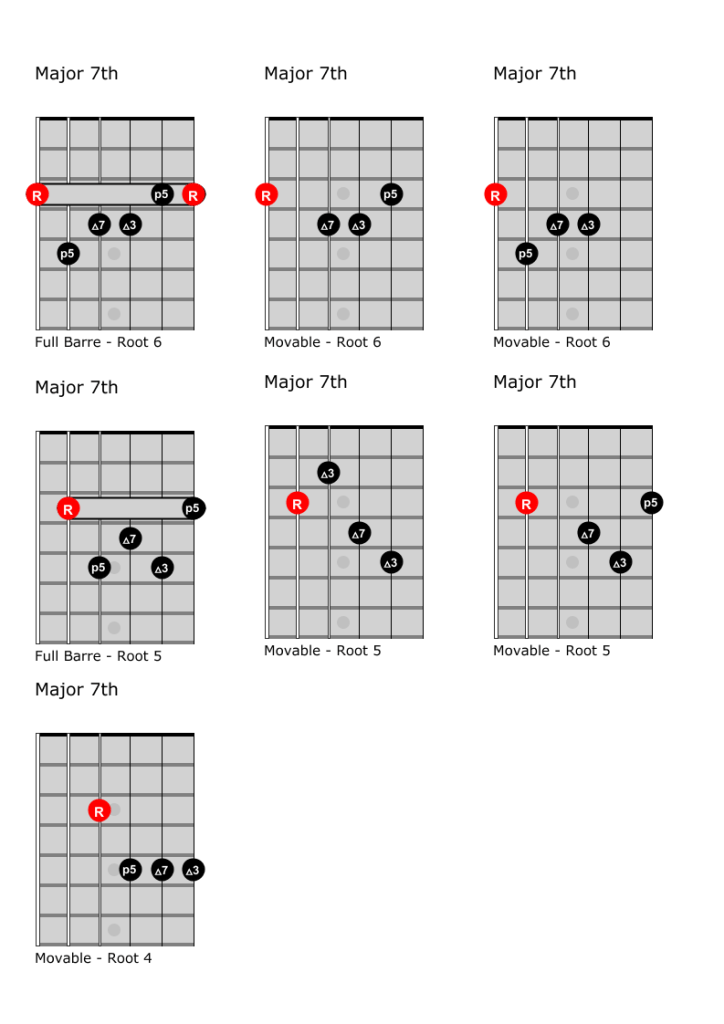
Easily placed or not, it’s a good place to start when it comes to cataloging voicings being the 4-note form of the first degree of the major scale. Below are all the voicings I find most useful for a Maj7.

Major 7th chords, useful voicings

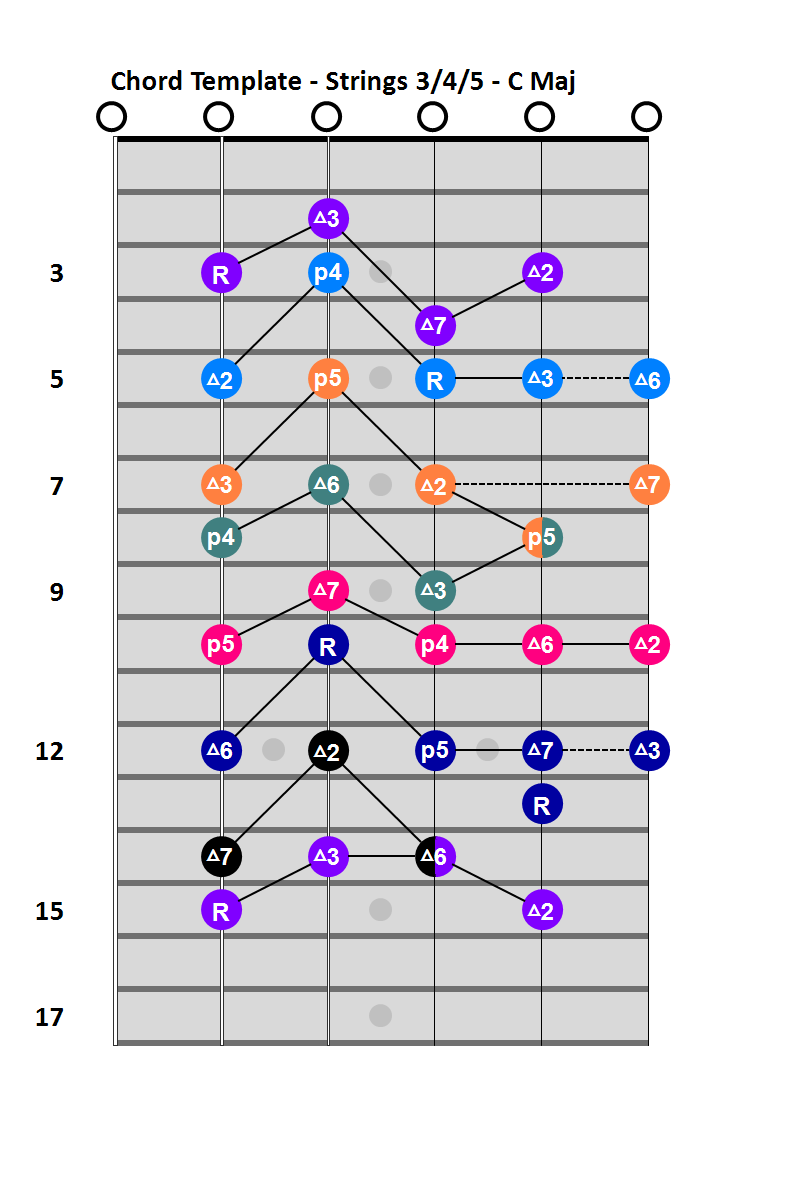
Chord Template 1: Strings 3/4/5

Chord template for strings 3, 4, and 5 in C Major

I’ve spent a lot of time working on chords and harmony lately, and I’ve concluded that I really need a good roadmap to move up and down or across the neck to speed the up the composition process. The most obvious place to start that wasn’t the 6th-string bar chords we all know was the 5th-string-root shape that seems to come up first for dominant 7th chords or the Hendrix chord. There are a few fantastic voicings in here.

The m9’s of the second and sixth degree are a chord I’ve highlighted before, and the m7 of the seventh was frankly a surprise. It never occurred to me to drop the flattened 5th to create a less tense seventh chord of the major scale, but it seems more useful than just avoiding the seven altogether. I also really like the maj7(add9) and maj7(add13) you get in the root and fourth positions. There’s a load of color on tap in this template. I’m looking forward to connecting seamlessly it across strings and to a larger set of voicings.