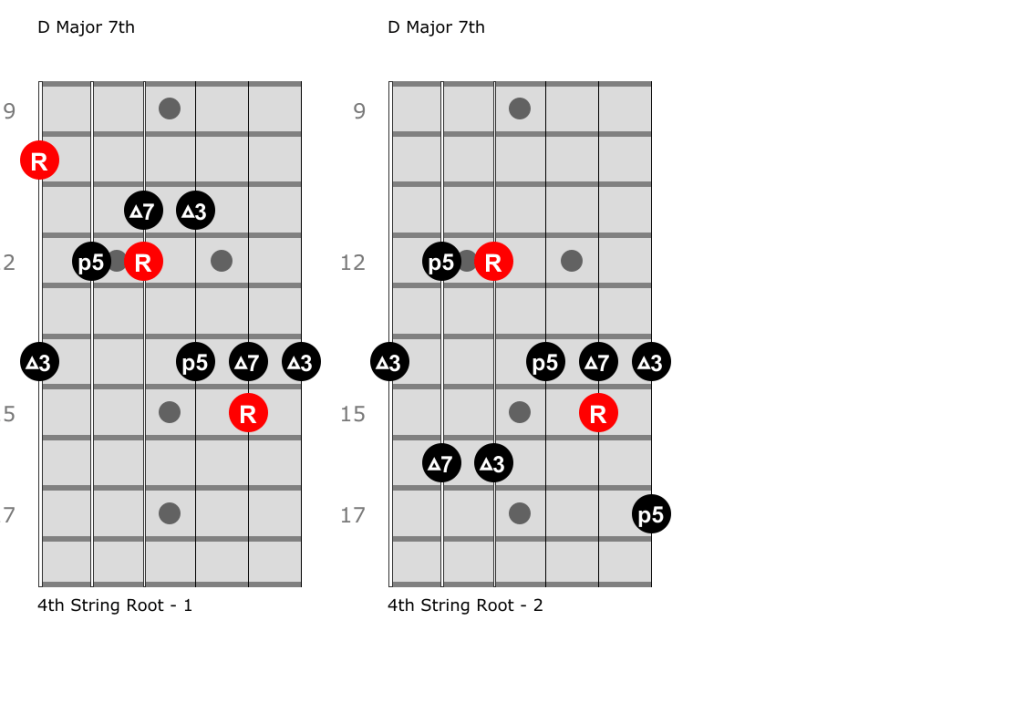
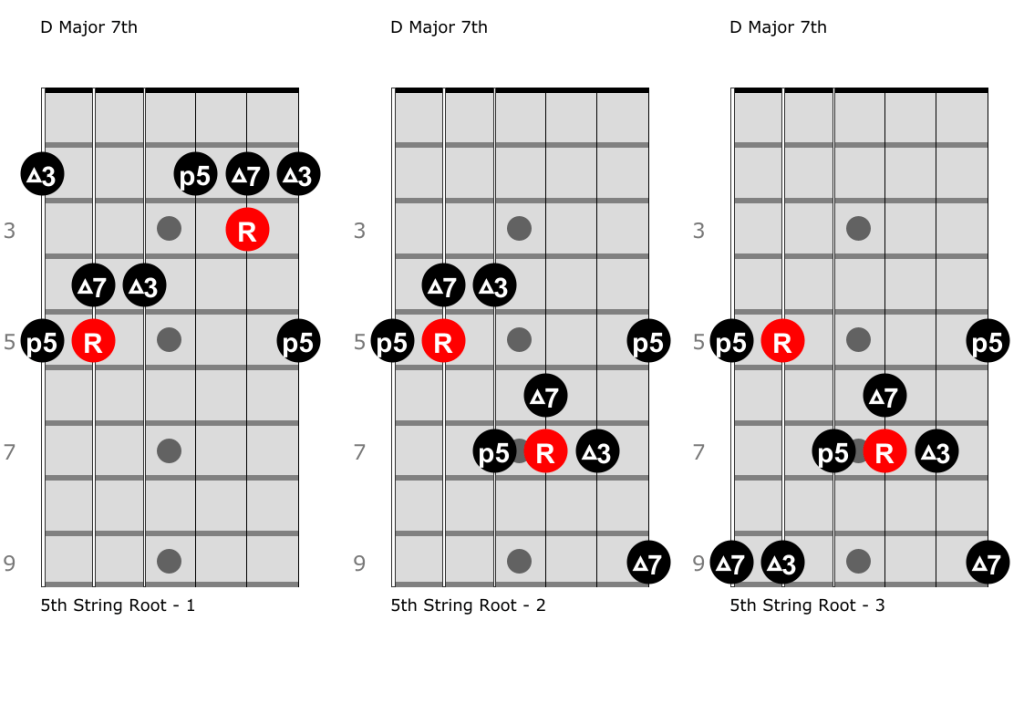
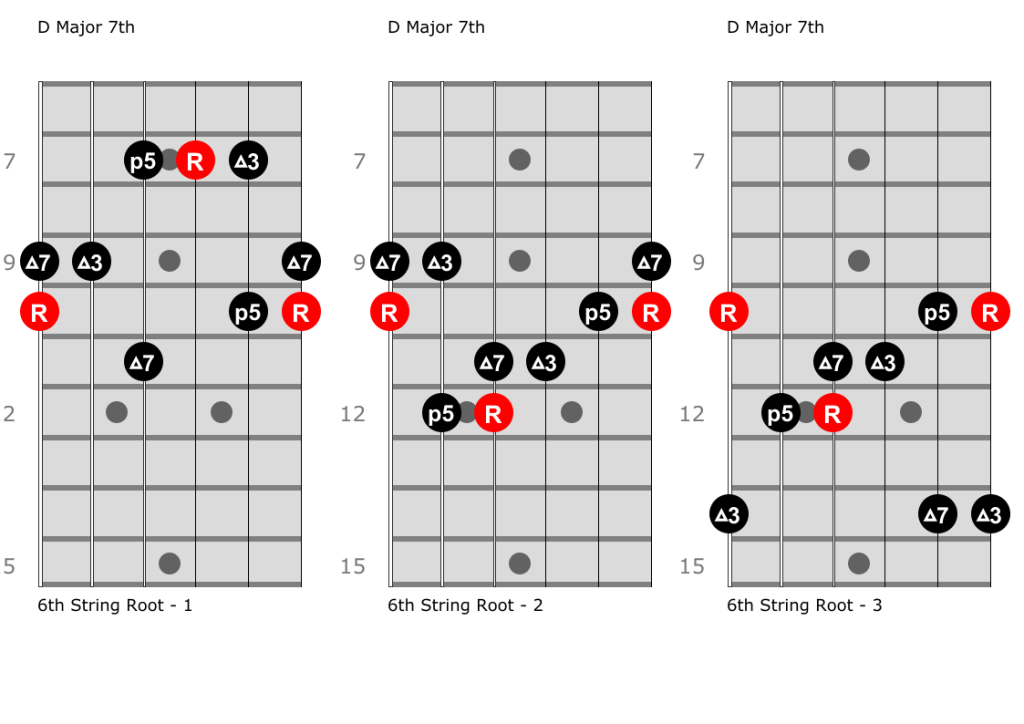
Major 7th Arpeggios

I’ve learned Maj7 arpeggios more than once from different teachers (thank you Eyal Maoz) and printed sources. Most seemed to stick to the five basic CAGED shapes, but when working them out again recently, I concluded that I like thinking about them from root location. There are three core positions for both 6th string and 5th string roots and then only two when you get to the 4th string given the overlap with the 6th string root. I’m posting them here for my own reference as much as anything, but hopefully someone else will also find it useful. I’ve used D as a reference given that I tend to begin with the 5th string root shapes and prefer to practice these without using an open string.

Practicing guitar with a new baby

My assumption upon having a child was that guitar progress was over. For the first few months, my assumptions proved correct, but once he’s begun sleeping through the night, leaving me with a modicum of sleep myself, I’ve found that I’m actually able to learn quite a bit while taking care of him. Many of his activities are self-directed play on a playmat or in a jumper, and he’s pretty much fully engaged with whatever has caught his attention. Obviously, he requires pretty much 24/7 oversight, but it’s entirely practical to sit with the guitar in hand while keeping an eye on him. I’ve currently focused on left-hand/pickless work so as to avoid leaving picks lying around in his path. These are the exercises I’ve found most amenable so far:

  • Legato Octaves: (Do this for each note in each position of the major scale). With left hand only, play up and down a full octave of the major scale twice, starting from the given note. Playing twice back to back helps to train your fingers to reverse back up from the bottom of the scale. When you reach the last note of the position where this is possible, reverse and do it descending. This for me is actually a good bit harder.
    Note (Oct. 2025): In retrospect, this is one of the most helpful and enjoyable exercises I’ve tried. I’m still working on this regularly, and it’s done more for my left hand strength and coordination than anything else I can remember in decades of guitar.
  • Legato 3/4/5 note repeats: This is the same idea as octaves but only three, four, or five-note blocks. Each of these groupings repeat nicely and help prepare your fingers for repeated legato runs in improvisation.
  • Legato 4/6 note pentatonic repeats: Same idea again as the two above but instead of using diatonic scale, use the pentatonic scale which extends across three strings for the six-note grouping.
  • Legato full-box runs: Run the full pattern for each diatonic or pentatonic box up and back. Good for endurance and getting used to moving across the fretboard.
  • Learn a random new chord: I’ve been using a brilliant iOS app named ChordBank to learn new chords and voicings. It’s easy to create a list of favorites to revisit, as they’re usually pretty easily forgotten.
  • Learn a random new lick: I have far too many Truefire courses that I never seem to find time for. Small windows of time are perfect for learning a single lick from one of the courses.
  • Tapping: I’ve been practicing a tapping workout that is simply moving across the strings in an extended diatonic pattern. On each string I tap the three note patterns using the index finger for the lowest note, one finger of the left hand, and a tap for the note two notes above. I then switch left hand fingers to cover both options in a given position. For an A Major Scale in 5th position, this would be 10-7-5, 10-7-5, 12-9-5, 12-9-5 as an example. It reads more complicated than it is once you know it. I repeat each of these a few times and then move across the fretboard.
  • Sing him songs: I’ve always wanted to work on singing while playing as well as singing period. He’s quite happy to sit in his chair and listen to songs for a good twenty-thirty minutes, something I’m not sure I could convince anyone else to do!
  • Practice fingerpicking patterns: I NEVER feel like I have the time to work on fingerpicking, but when you have two or three hour blocks of baby watching, it suddenly seems more reasonable…
Useful Resources: Guitar

Truefire: Truefire courses have been invaluable over the past few years. There’s a tremendous breadth and depth of content available, and it can frequently be purchased very inexpensively (sales with many classes at $5/ea.). The courses listed below have been particularly useful to me. I prefer purchasing outright, as I have been accumulating material for about ten years, but if you’re new, it’s not unreasonable to go the subscription route at one of their big sales (don’t pay full price). Even this Christmas, I added about 10 classes for 2024 focused entirely on rhythm playing. Three of those courses were produced by Robben Ford, Ariel Posen, and Greg Koch. It’s incredible to have access to this level of instruction for minimal cost. I often wonder how much better a musician I’d have been had it been available to me back when I was 15.

This page is meant to be an evergreen collection of resources I’ve found useful in improving playing skill and understanding. It is currently and will remain a work in progress.

Practice Thoughts: Things that slow me down…tips that help make progress

I’ve been quite limited in my practice time lately, so I’ve had to focus on improving its quality. An interesting post on TGP suggested one trick (mentioned later), and I’ve noticed a few others myself. This post exists to catalog small factors that I have found reduce my ability to play accurately and quickly as well as methods to make more consistent progress. It’s meant to capture the small things that have an outsized impact:

  • Over-complicated picking: The main exercise I’ve focused on is the simple sextuplet exercise from the Paul Jackson Jr. video below. I found the turnarounds particularly problematic. Only by making the decision to start each six-note phrase (upwards and downwards) with a downstroke was I able to break past the first barrier that I struggled with. I was never actively trying to maintain alternate picking or any sort of economy picking plan, but moving to a downstroke-only initial note gave me a consistent starting point that allowed me to make progress when I’d been quite stuck.

    https://youtu.be/2g37NtzmTsY?si=4DKfsdDNfIUcy9vT&t=279
  • Slow elbow/forearm: Recently I’ve noticed that I’m most frequently botching notes when I’ve not moved my hand fully into position, and I’m trying to make up for it by bending my wrist. In the Paul Jackson Jr. exercise, you’re frequently traversing three separate strings. If you aren’t moving your hand (from the elbow) into position properly to pick the current note, you try and make up for it by bending your wrist and adding more complexity to the action. For me, this leads to quite a few more botched notes and progress stopping. It’s also something I didn’t consciously realize was happening. Focusing on getting the pick over the right string quickly helped cut down on these gaffs.
  • Underdeveloped upstrokes: A great thread on TGP that I’ll have to dig up talked about practicing only upstrokes and only downstrokes. I’ve added this into my routine as a quick warmup ahead of a main exercise. I simply ascend and descend the scale/position (say A Dorian at the 5th fret) using only upstrokes and only downstrokes at half speed and then alternating at full speed. Typically I use the target end speed for the exercise I’m working on as the full speed for this warmup. This gets me practice at ‘full’ speed and still allows me to work on the individual upstrokes and downstrokes at reduced pace. Doing this highlighted how much weaker my upstrokes were/are relative to my downstrokes. This is a work in progress, but a heretofore unknown impediment.
  • Wrong picks: I wouldn’t say I’ve nailed down a perfect all-around pick for me, but I’ve discovered a number of things that don’t work. Very small picks are a definite no-go. Picks with a sharp point, while preferred by many, simply don’t feel right to me. Nor do picks with a very broad edge. I know many like very thick picks for speed, but that’s also a no for me. Nor are very thin picks for obvious reasons, at least for single-note work. I’ve ruled out quite a few picks here, including some favorites like the Jazz III. What HAS worked are standard shape picks that aren’t overly thick but are still rather rigid. My favorite here has proved to be Graphtech Tusq picks in the normal shape. Most of what I have are the yellow .88mm variety, but I’m interested in testing the 1.0mm across the range of colors (supposed to reflect brightness of attack). This remains an ongoing pursuit and is open to evolution, but it’s worth considering what picks truly work for you.

    https://graphtech.com/collections/tusq-picks-standard
  • Never practicing at a stretch tempo: Until very recently, I was only working at the maximum tempo I’d achieved for the specific exercise I was working on. Recently, I’ve begun doing the simple downstroke/upstroke/both exercise at a tempo well above the max tempo I’ve managed for the exercise in focus. This gives me practice at both a controlled low speed (downstrokes only & upstrokes only) and at a stretch tempo (both simultaneously) on a simpler exercise in addition to the main effort.

Things that help:

  • Picking one exercise at a time: Most of the time I start a regimen with the best intentions. It’s purposeful, specific, and relatively limited. Unfortunately, my proverbial eyes are always bigger than my stomach, and so the list of exercises grows until its become an unwieldly group covering every possible thing I’d like to improve. As someone with far too little time to devote to the pursuit, this shortly proves unworkable and discouraging. This year, I’ve focused on one exercise with the goal of working on it specifically until I’ve hit a target pace. From there, I can make a decision on what’s next. What this has allowed for has been far less backtracking and slow but steady progress. I still play and record all sorts of unrelated bits, but when it comes to working on simple performance capacity, I always know what exercise I’m working on, what tempo I’m at, and where I want to get. This allows me to easily take advantage of smaller bits of downtime, as there’s minimal overhead in popping out the cell phone metronome and picking up where I left off. If you have four spare hours a day for musical improvement, this likely isn’t for you, but if you don’t even consistently get four hours of uninterrupted sleep, maybe it is.

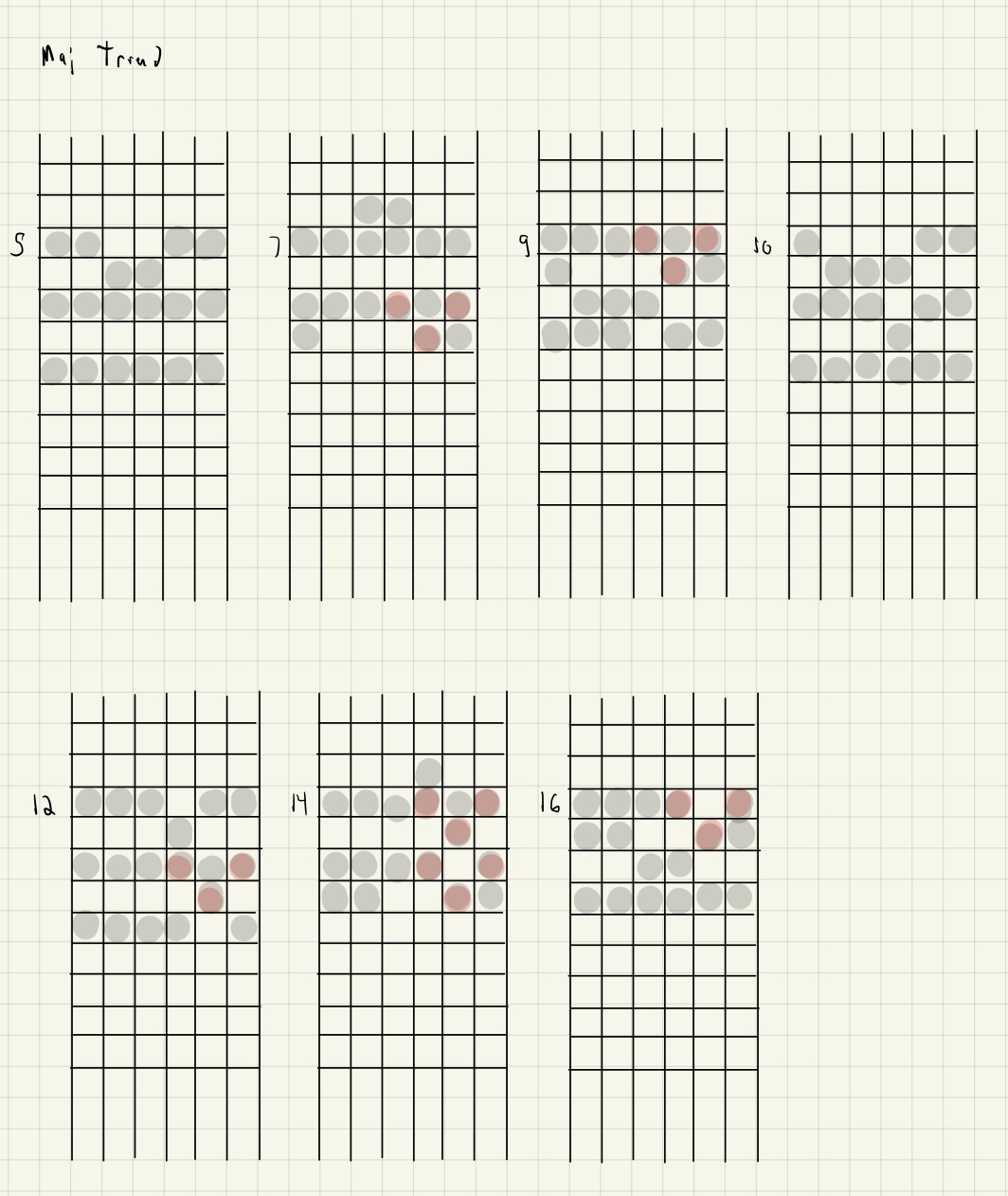
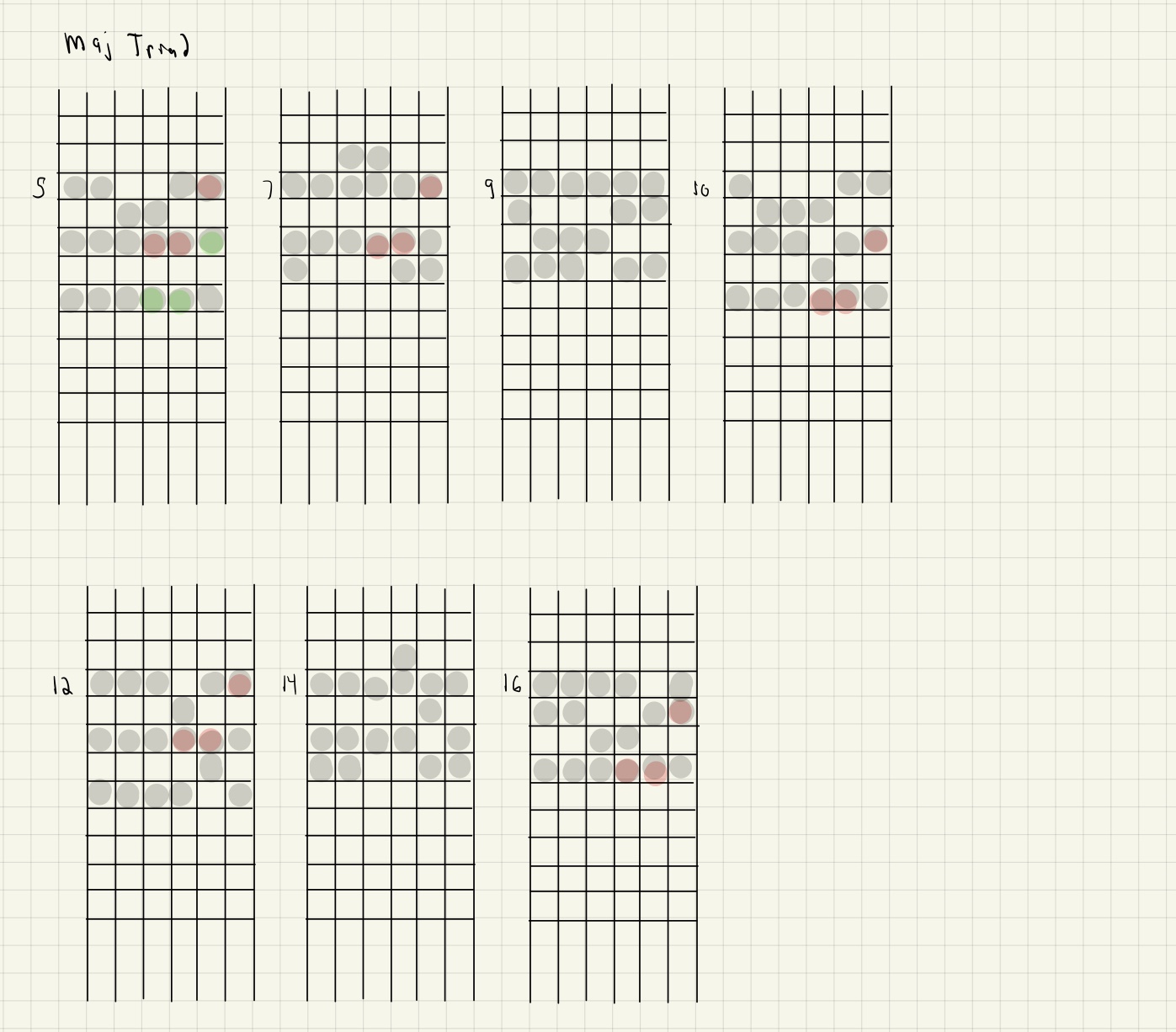
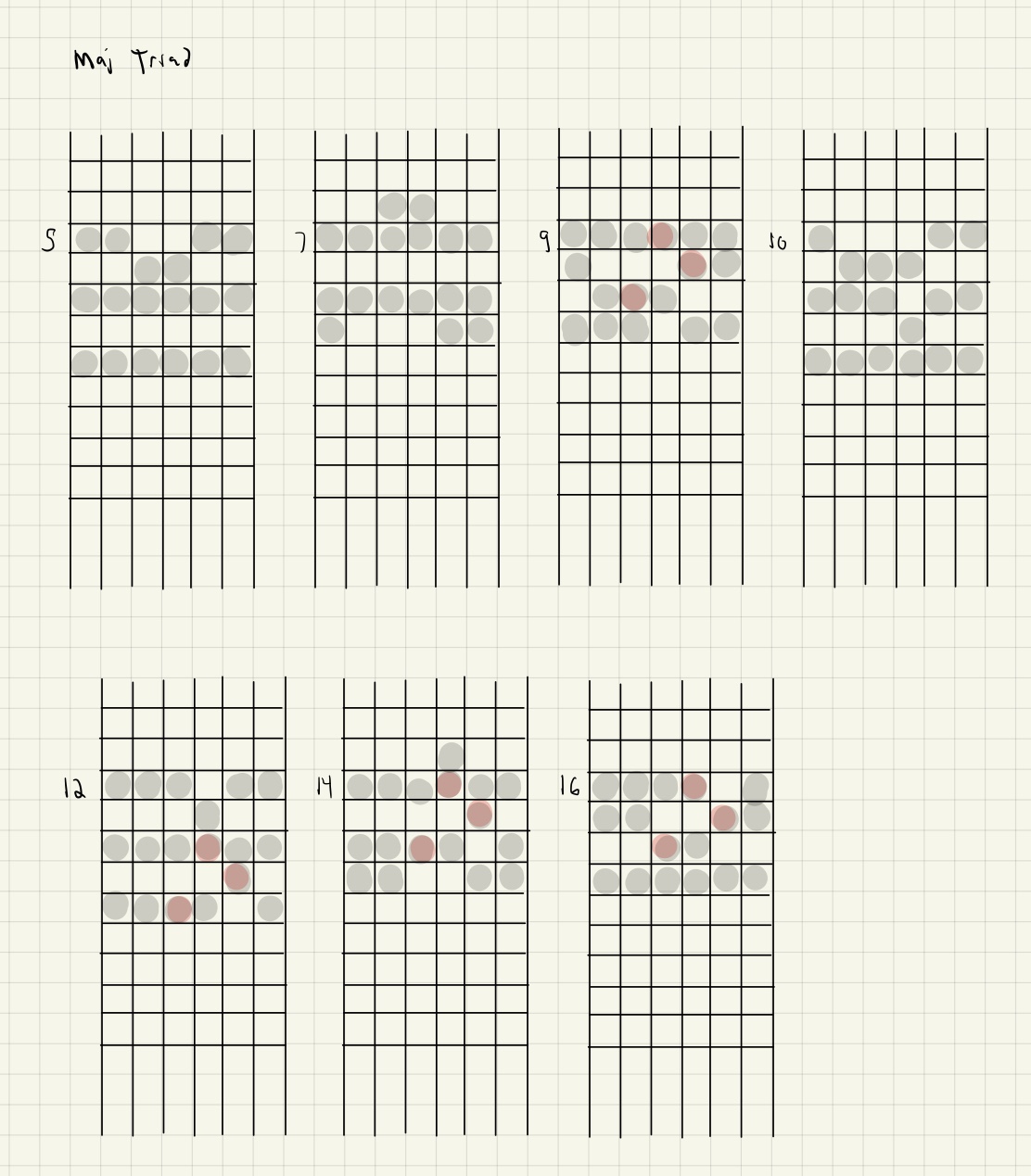
Triads in Position – Major

I have a terrible time keeping track of where the various triads live within the diatonic patterns, so I’ve begun drawing them out. I find transitioning between triads during improvisation (same shape, different position) to be an interesting way to move around the neck. I only used the top two string sets, as that’s where I find tend to use them.

Min 6 Chords

To be fair, I mostly threw this one in for the sake of completeness. I won’t claim I’ve had much success with the min6, though I did enjoy the root-5 variation that looks like an ‘M,’ as it is easily dropped to a minor add-b13 chord that I’d never played before. I also found that this chord works much better for me in arpeggio form. Sounding the notes individually scales the heavy dissonance back to a more usable tension, a strategy I plan to test further in other chords I’ve had trouble using.